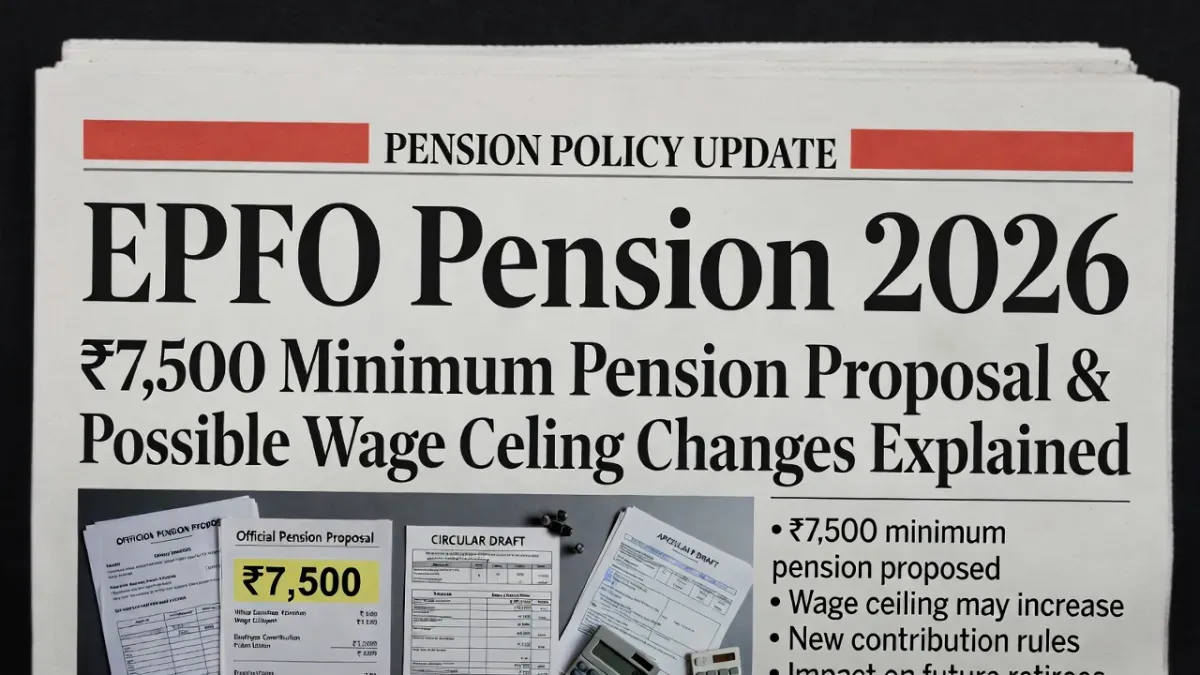
Retirement security has become an important topic in India as policymakers review whether the current pension system meets today’s living costs. Discussions are ongoing about raising the minimum monthly pension under the Employees’ Pension Scheme to ₹7,500. At the same time, there is consideration of revising the wage ceiling used for pension contributions. These possible changes could affect millions of private-sector employees who depend on this scheme for steady income after retirement.
Under the existing structure, employees contribute to the provident fund during their working years. While the provident fund amount is usually withdrawn as a lump sum at retirement, the pension component provides regular monthly payments for life. However, the current minimum pension of ₹1,000 per month has been widely criticised as insufficient in today’s economic environment.
Why Pension Adequacy Is Under Review
The need to revise pensions has become stronger as the cost of living continues to rise. Food prices, rent, utilities and especially healthcare expenses have increased significantly over the past decade. For elderly citizens, medical expenses often form a major part of their monthly budget.

When the minimum pension was fixed at ₹1,000 in 2014, it was considered a basic safety measure. Today, that amount offers very limited support. Many retirees argue that a higher minimum, such as ₹7,500, would better reflect real-life expenses. Policymakers are therefore examining whether the system needs adjustment while also considering the long-term sustainability of the pension fund.
How the Current Pension Formula Works
The pension amount under the Employees’ Pension Scheme is calculated using a formula based on pensionable salary and years of service. However, contributions are subject to a wage ceiling. This means that even if a worker earns more than the specified limit, pension contributions are calculated only up to that cap.
Because of this ceiling, many employees with moderate salaries end up receiving lower pension amounts than expected. Revising the wage ceiling would allow higher contributions, which could lead to larger pensions in the future. However, such a change would also increase payroll costs for employers and slightly reduce take-home salary for employees due to higher contributions.
Also Read:
 Holi Closures, Long Weekends, And Important Banking Schedule Details -Bank Holidays In March 2026
What a ₹7,500 Minimum Could Mean for Retirees
If the proposed ₹7,500 minimum pension is approved, it could significantly improve the income of those currently receiving very small amounts. For example, a worker who spent decades in a low-paying private-sector job might currently receive less than ₹2,000 per month. An increase in the minimum pension could provide meaningful financial relief.
However, it is important to understand that pension increases are usually linked to eligibility rules, contribution history and service duration. Any change may be introduced gradually or with specific conditions. Not every pensioner may automatically receive the full proposed amount.
Impact on Current Employees
For employees who are still working, these discussions highlight the importance of long-term retirement planning. Even if the minimum pension is increased, it may only cover basic living expenses. Middle-income earners may still need additional savings to maintain their desired lifestyle after retirement.
Also Read:
 Calculation method, eligibility criteria, and benefit structure explained Gratuity Rule 2026 Update
Financial advisors often recommend combining statutory pension benefits with voluntary savings options such as mutual funds, annuities or the National Pension System. This approach creates multiple income sources and reduces dependence on a single scheme.
A higher pension floor can strengthen trust in the formal retirement system, but personal financial planning remains essential.
Funding and Sustainability Challenges
Any significant pension increase must be financially sustainable. Pension schemes operate on long-term projections, balancing incoming contributions with future payouts. Raising the minimum pension to ₹7,500 would require additional resources.
Also Read:
 Key charges, limits and updates explained SBI, PNB, and BOB minimum balance rules for 2026
These resources could come from increased contributions, government support or adjustments within the scheme. Policymakers must carefully evaluate these options to ensure that the fund remains stable for future generations.
Previous pension revisions have followed detailed reviews and actuarial studies. Similar analysis is expected before any final decision is made regarding the current proposal.
Staying Informed Through Official Sources
Whenever pension-related discussions gain attention, misinformation can spread quickly. Employees and pensioners are advised to rely only on official announcements and verified communications. Any approved change would be formally notified and reflected in official records.

Individuals can also review their contribution history and pension details through authorized online platforms. Understanding current benefits helps set realistic expectations and prepares individuals for possible future updates.
Conclusion
The proposal to raise the minimum EPFO pension to ₹7,500 and revise the wage ceiling reflects growing concern about retirement security in India. Rising living costs and demographic changes have increased pressure to modernize the pension system. While the proposal offers hope for better financial stability among retirees, it remains under review.
If implemented carefully, such reforms could improve income support for millions of pensioners. At the same time, long-term financial sustainability and personal retirement planning will remain crucial components of India’s broader social security framework.

Disclaimer: This article is for informational purposes only and is based on publicly discussed proposals and available reports. The proposed ₹7,500 minimum pension and wage ceiling revisions have not been officially implemented at the time of writing. Final rules, eligibility criteria and timelines may change following government approval. Readers are advised to verify details through official EPFO communications or consult qualified financial professionals before making decisions.